

Durres Amphitheatre Guide: Explore Albania’s Ancient Roman Arena by the Sea

Updated: Aug 26
Located in the center of Durrës, Albania's second-largest city, the Durrës Amphitheatre is a symbol of the area's rich history and Roman heritage.
Being one of the largest Roman amphitheaters in the Balkans, dating back to the 2nd century, it is a must-see for both history buffs and inquisitive travelers.

Although Durrës Amphitheatre is quite large, it can be surprisingly difficult to locate, even though it's situated in the heart of a city that has expanded around and even atop this remarkable piece of Roman history.
It is not very well signposted, although once you see the ancient walls and beautiful gardens that surround it, you're pretty much there.
In this post, we’ll cover all you need to know about the Durrës Amphitheatre, from its fascinating history and interesting facts to practical travel information from our personal experience visiting this incredible site.

This is one of the must-see landmarks featured in our Durrës travel guide, where we explore the city’s mix of history and coastal life.
Key Takeaways
● Why it matters: The Durrës Amphitheatre is the largest Roman amphitheater in the Balkans, with an estimated capacity of 15,000–20,000 spectators.
● Remarkable discovery: The 2nd-century arena was buried beneath later development and only rediscovered during construction work in 1966.
● Our impression: Its scale is easy to underestimate at first, but seeing an ancient arena embedded within modern Durrës makes the site especially memorable.
In This Post...
See More...
Our Durres Amphitheatre Highlights
The Durrës Amphitheatre was discovered in the 1960s, and excavation was tricky owing to the properties that were built over it, such was the depth at which it had been buried.
It is said that the last gladiator fights occurred here in the 5th century, when the city was known as Dyrrachium, with the site being taken over by Christians for religious events as the Roman Empire entered its dying days.

Sometime around the 7th century, the city was renamed Durrës, and as it began to expand into Albania's 2nd-largest city, the amphitheater was abandoned, buried under layers of earth, and eventually built upon. But more on that later!
The history and story of this great theater were always going to attract us, and we were very excited to see it.
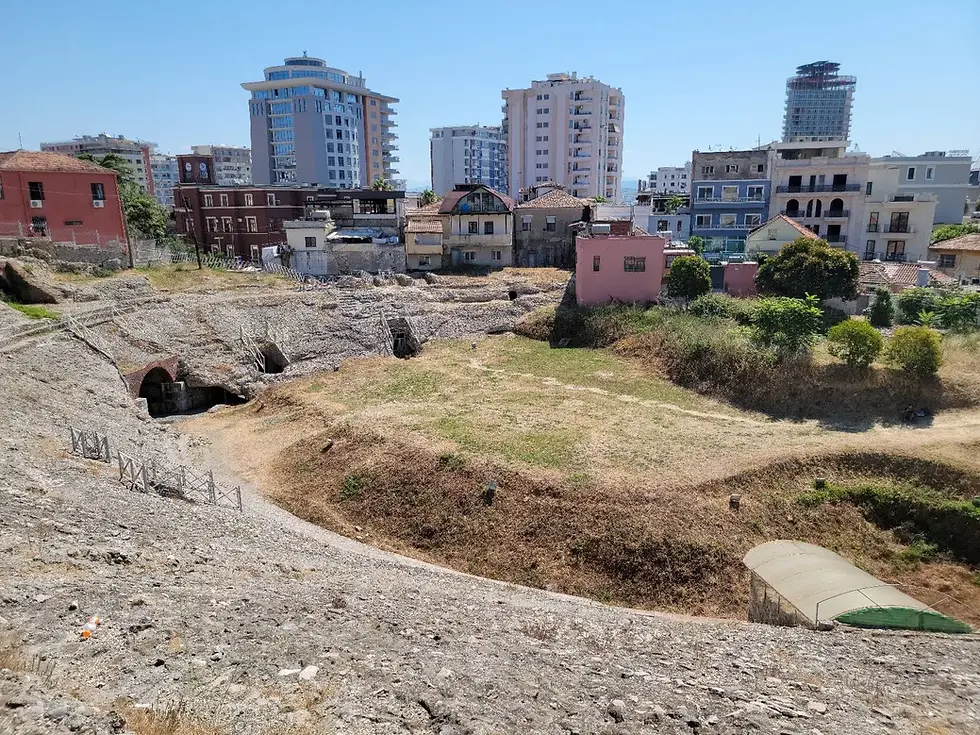
A pathway has been constructed that leads to a really good viewpoint above the amphitheater, where one can get a good feel for its size. And it is big indeed.
Restoration efforts have been pretty slow here, and the lack of progress is probably the main reason Durrës Amphitheatre has yet to be granted World Heritage status.

The main arena floor is still covered in grass, and you can see some houses and other structures that are yet to be removed, most likely covering the missing part of the ring.
You are able to walk around the entirety of the amphitheater, although it is now fenced off, and you are not able to access the seating areas or the center area.
You are able to see a small mosaic and the remains of a Christian chapel at the front, along with one of the tunnels, for a small charge of 300 lek.

It was closed when we arrived, although the free view from the top of the amphitheater felt more than worth it in itself.
There seems not to be much effort to capitalize on tourism here just yet, and the site still feels very raw and underdeveloped.
There aren't any information boards or brochures, and if you choose not to visit the chapel, it will not take long to check it all out.
That being said, it is one heck of a piece of history, and if you want to know more about that, read on!
The History Behind the Durres Amphitheatre
The city of Durrës, originally known as Dyrrachium in ancient times, has a history stretching back to the 7th century BC.
Founded by Greek colonists from Corinth and Corcyra, Dyrrachium became a prominent settlement due to its strategic position along the Adriatic Sea, making it a key hub for trade and military operations in the region.
During the Roman era, Dyrrachium rose to prominence as an essential link in the Via Egnatia, a significant road connecting Rome to Byzantium (modern-day Istanbul).
It was during this period, in the 2nd century AD under the reign of Emperor Trajan, that the magnificent Durrës Amphitheatre was constructed.
This grand structure was designed to host gladiatorial games and other public spectacles, accommodating up to 20,000 spectators, which made it one of the largest amphitheaters in the Balkans.
The amphitheater’s architecture reflects Roman engineering mastery, with a combination of underground tunnels, vaulted seating, and an intricate drainage system.
These features allowed for the smooth operation of the games and provided a captivating experience for the audience.
The structure served as a cultural and social focal point for the city during its heyday.
As the Roman Empire declined, so did the significance of the amphitheater. By the 4th century AD, parts of the structure began to be repurposed.
During the Byzantine period, a small chapel was constructed within the amphitheater, adorned with stunning mosaics that reflected the shift toward Christianity.
Over the centuries, the site was gradually abandoned, buried under layers of earth, and forgotten.
The amphitheater was rediscovered in the 1960s during urban construction work in Durrës.
As workers were excavating for new buildings, they uncovered parts of the amphitheater’s structure.
This accidental find sparked archaeological interest, leading to extensive excavations that revealed the amphitheater’s impressive scale and historical importance.
Many of the recovered artifacts can be found at the Durrës Archaeological Museum.
10 Interesting Facts About the Durres Amphitheatre
● It’s the largest Roman amphitheater in the Balkans: Measuring approximately 136 x 113 meters, it once seated 15,000–20,000 spectators, making it the largest of its kind in the region.
● Built in the 2nd century AD: Historians believe the amphitheater was constructed during the reign of Emperor Trajan, around 100–110 AD, when Dyrrachium (modern Durrës) was a major Roman city.
● Gladiator battles were held here: Just like the Colosseum in Rome, the Durrës Amphitheatre hosted gladiatorial combat, wild animal fights, and public spectacles.
● A chapel was added in the 4th century: During the early Christian period, a Byzantine chapel with beautiful mosaics was built inside the structure, some of which are still visible today.
● It was hidden underground for centuries: After earthquakes and urban development, the amphitheater was completely buried and forgotten until 1966, when a local construction worker stumbled across it.
● It’s still partially buried: To this day, much of the amphitheater lies beneath houses and streets, as full excavation would require major restructuring of the city center.
● You can walk through ancient tunnels: Visitors can explore original underground passages once used by gladiators, performers, and animals preparing for battle.
● The site blends Roman and Christian history: It’s rare to find a Roman arena with preserved Christian elements, showing the site’s transition from pagan entertainment to religious use.
● It survived multiple earthquakes: Durrës is in an earthquake-prone region, and the amphitheater has withstood several over the centuries, though parts have collapsed and been rebuilt.
● It’s on UNESCO’s tentative list: While not yet a full UNESCO World Heritage Site, the Durrës Amphitheatre is on Albania’s tentative list, recognized for its cultural significance and potential.
Ticket Prices, Opening Times & Best Time to Visit
Tickets are available on-site only, at the small kiosk near the main entrance. Cash preferred—bring small notes if possible.
Ticket Prices
Adults
300 ALL
Children & Students
150 ALL
Guided tour (optional)
Additional 500–700 ALL, depending on provider
Entry includes
Access to the amphitheater interior, underground tunnels, chapel mosaics, and museum panels
All prices are in Albanian leks and are subject to change. Check the official website below for the most up-to-date information.
Convert your currency here.
Opening Times
Summer (April–October)
Daily, 9 am – 8 pm
Winter (November–March)
Daily, 9 am – 4 pm
Closed
On major public holidays
Best Time to Visit
● Early morning (before 10 am) or late afternoon (after 5 pm) to avoid heat and tour groups
● Spring & autumn offer ideal weather with fewer crowds
● In peak summer (July–August), bring sun protection—the site is very exposed
How to Get to the Durres Amphitheatre
The Durrës Amphitheatre is located right in the city center, just a few minutes’ walk from the main square and Durrës promenade.
By Bus
From Tirana’s International Bus Terminal, take a Durrës-bound bus or furgon (~150–200 ALL). Buses arrive at Durrës Bus Station, about a 10–15 minute walk to the amphitheater.
By Car
● From Tirana: 35–45 minutes via SH2
There are paid parking lots near the promenade or street parking around the old town, but spots fill quickly in summer
On Foot
If you're staying in Durrës, the amphitheater is easily reachable on foot from most hotels or beachfront accommodations. It’s tucked behind a few local streets, with signage pointing the way.
.
Car Rental
Getting to the Durrës Amphitheatre is relatively straightforward, with many of the city’s attractions located close together near the centre and coastline. Most visitors can explore the main sights without needing a car.
Car rental becomes more useful if you plan to travel beyond Durrës and explore more of Albania at your own pace. Use the search tool below to find the best car rental deals for your trip.
🎟️ Consider Taking a Tour From Tirana
The Durrës Amphitheatre is one of Albania’s most impressive historical sites, but reaching it is often easiest as part of a day trip from Tirana. Many tours combine the city’s Roman history with coastal views and nearby attractions, making it a simple and rewarding way to visit.
Contact Information for the Durres Amphitheatre
Address
8C6W+V2M, Rruga Kalase, Durrës, Albania (Dyrrhachium Archaeological Park)
Phone
(+355) 5222-2310
Easily Find Hotels in Durres and Beyond
Looking for a place to stay nearby? Browse Durres hotel deals below to find great rates from top providers in the city.
Our map offers a user-friendly interface that allows you to zoom in and out, providing a comprehensive view of the area and enabling you to identify the most convenient hotel options based on your current location or desired destination.
Tips for Visiting the Amphitheatre in Durres
● Bring water and sun protection: There’s minimal shade inside the site. A hat, sunscreen, and a bottle of water are must-haves—especially in summer.
● Visit early for the best light: Morning light illuminates the curved structure beautifully and gives the best photos without harsh shadows.
● Watch your step: Some areas are uneven and slippery, especially near the underground tunnels and mosaics—sturdy shoes are recommended.
● Combine with other nearby attractions: The Byzantine Forum, Venetian Tower, and Archaeological Museum are all within walking distance. Easily done together in a half-day.
● Local cafés and shops nearby: Once you're done, grab a coffee or bite at one of the nearby cafés in the old town—many have castle or sea views.
Watch on YouTube: Our First Impressions of Durres
If you're considering a city to explore in the Balkans, Durres should certainly make your list. This city offers numerous activities, beaches to enjoy, and a rich Roman history for enthusiasts.
Additionally, its location is ideal for accessing many other fantastic spots in Albania and neighboring countries.

If you enjoy our video and want to follow more of our adventures, please like and subscribe!
Your support truly is invaluable to us, and we will always strive to produce the best content we can from around the world!
Our Experience Rating:
Durres Amphitheatre

It might not seem like much at first, but the Durrës Amphitheatre, being the largest of its kind in the Balkans, instantly makes it special. A 20,000 capacity?
That is more than some Premier League football grounds! With only half of the site currently excavated, there is no doubt that much more is to come from this World Heritage Site candidate.
Visiting the Durrës Amphitheatre is a fascinating journey into Albania’s ancient past and is well worth checking out.
We were struck by the contrast against the modern cityscape of Durrës, and even if you do not grab a ticket, you can still catch a great view and escape the city at the same time.
Besides, if you have made it this far into this post, you are probably convinced already!
Historic sites like the Durrës Amphitheatre reveal Albania’s deep Roman roots and cultural heritage. For more destinations and travel inspiration, explore our Albania travel guides.
FAQ: Durrës Amphitheatre
Where is Durrës Amphitheater?
The amphitheater is in the heart of Durrës, Albania, just a few minutes' walk from the main square and promenade. It's nestled among modern buildings, making its sudden appearance all the more striking.
How old is the amphitheater?
It dates back to the 2nd century AD, during the reign of Roman Emperor Trajan. Once the largest of its kind in the Balkans, it could hold up to 20,000 spectators.
Why is the amphitheater unique?
Beyond its size and age, it features a rare 5th-century Christian chapel inside, with preserved mosaics, showcasing the site’s evolution from pagan entertainment to Christian worship.
What are the hours and prices?
Typically open daily from 9 am to 4 pm (may vary by season)
The entry fee is modest, usually around 300–400 lek (€3–4)
Local guides may be available on-site for an extra fee.
Are tours available?
Yes. There are interpretive signs in English and Albanian, and local guides may be available outside the entrance or through tourism offices.
How long should I spend?
Plan for 30–45 minutes to walk around the amphitheater, explore its interior chambers, and take photos. Longer if using a guide or audio tour.
Is the site family-friendly?
Yes! It’s an open-air site with plenty of space to roam, though be cautious with uneven stone paths and steps.
Is the site accessible?
Due to its ancient structure and uneven surfaces, it’s not fully accessible, but you can still enjoy views from the street-level perimeter if mobility is a concern.
What else is nearby?
● Archaeological Museum of Durrës
● Venetian Tower
● Durrës promenade and beachfront cafés
● Local shops and bakeries within walking distance
Is the amphitheater worth it?
Absolutely. It’s a remarkable piece of Roman history tucked within a bustling Albanian city, offering a mix of archaeology, culture, and a glimpse into Durrës’ layered past.



This should totally make the World Heritage Site list at some point!